1.9.2023 – 19.9.2024
Kunsthaus Zurich, various locations
Brigit Meier and Seline Fülscher
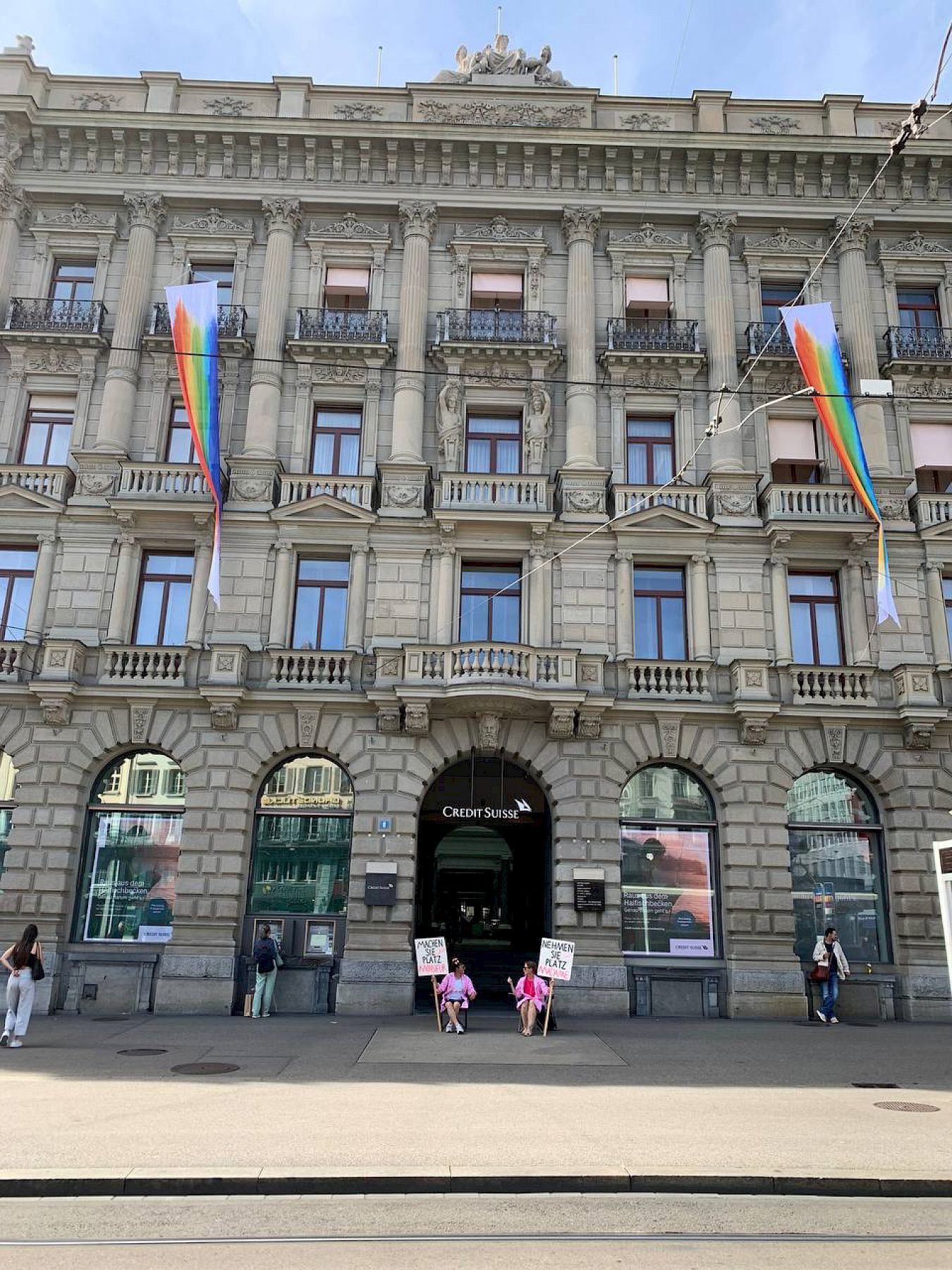
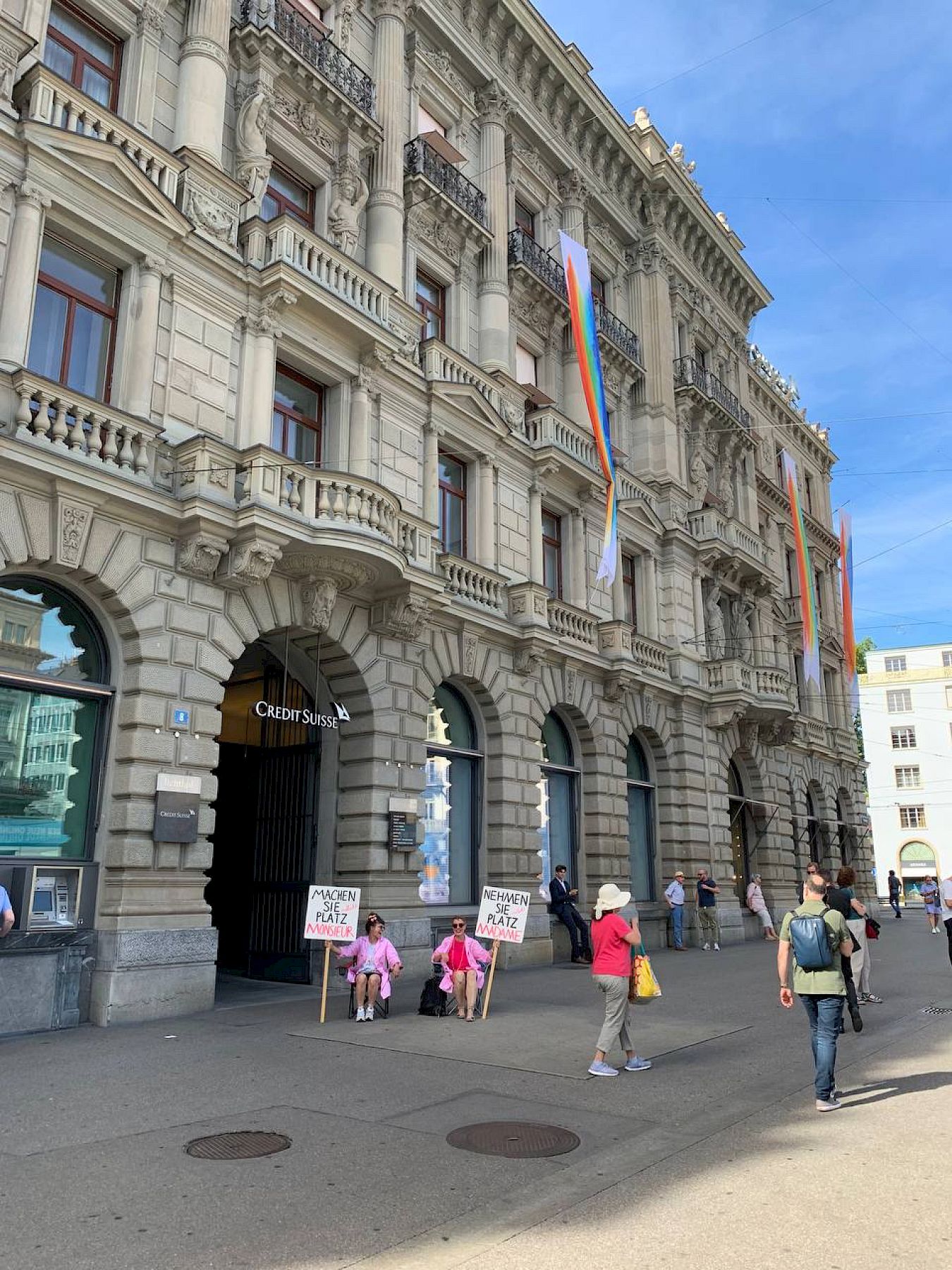
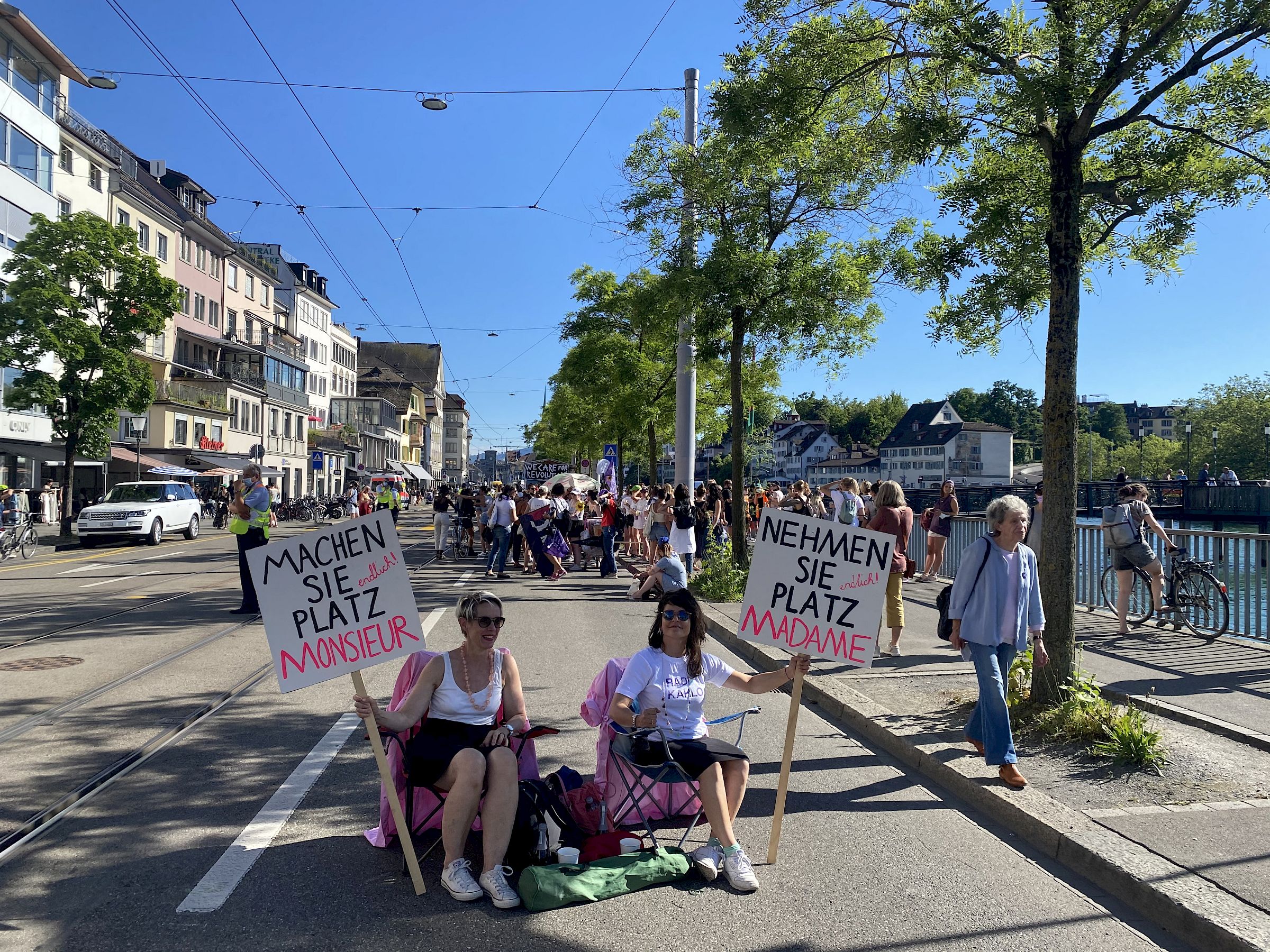
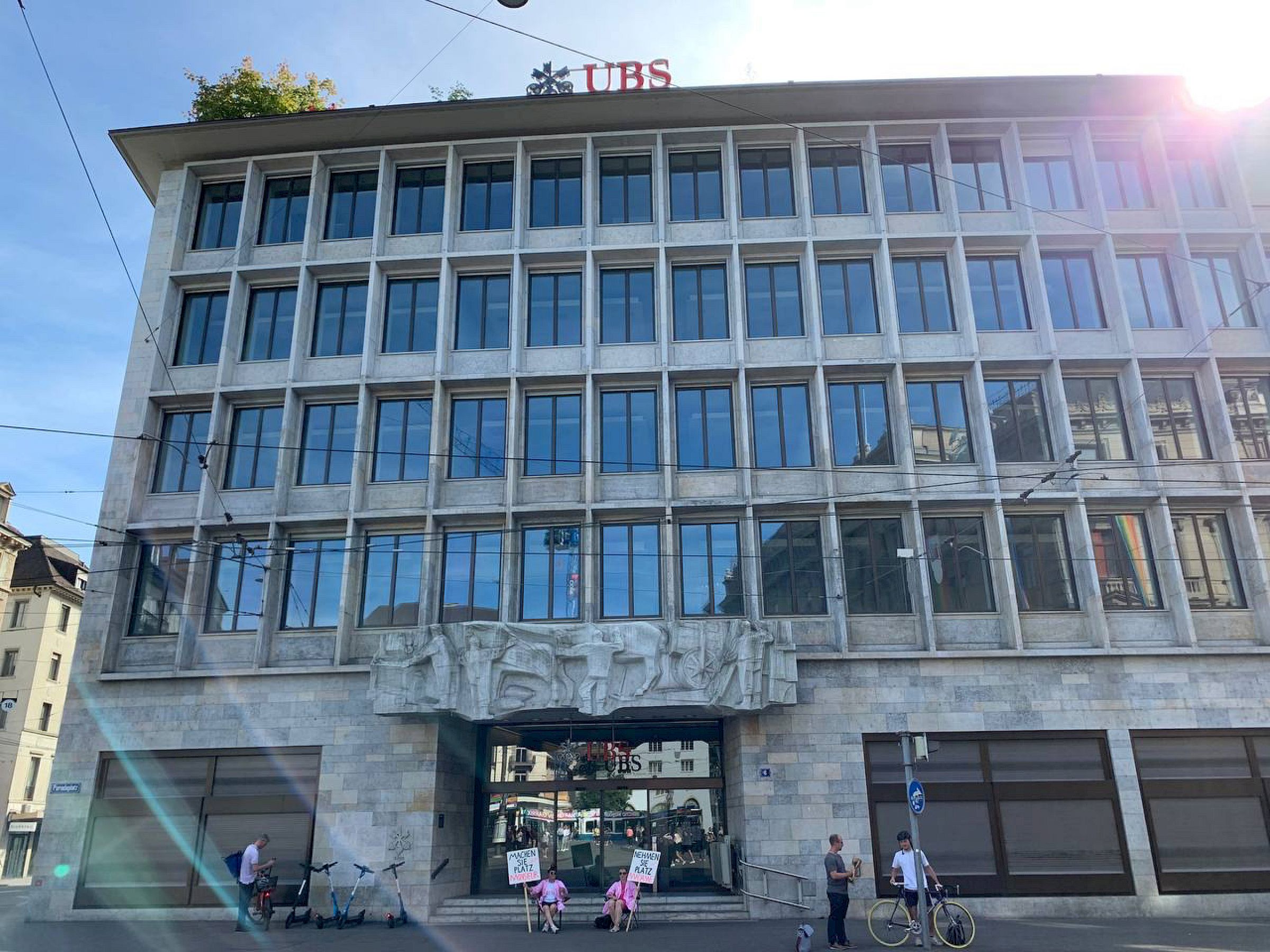
Make room, Monsieur - Take a seat, Madame, 1991, 2019-2023
Installation at Kunsthaus Zurich: folding chairs, strike signs, Radi Kahlo smock, photos
On the day of the first Women’s Strike in 1991, Andrea Bislin and Brigit Meier, artists and mediators of art, sat with their placards on Paradeplatz in Zurich (photo on the left). Since 2019 Meier along with Seline Fülscher has repeated this action at each Women’s Strike and on Women’s Day in places with patriarchal associations such as Europaallee, Paradeplatz in front of the banks, the central station, etc.
As these activists work in the field of art, they are now increasingly choosing cultural institutions such as the new and old buildings of Kunsthaus Zürich, the opera house or the Landesmuseum. The slogan of 1991 became one of the most important statements of the Women’s Strike. It not only tells the monsieurs to move over and reduce their claims to exercise power, but also encourages and empowers women to occupy all spaces, positions and places in society.
The pink artist’s smocks represent the professional origins of the activists. They are part of the screen-print collection of Seline Fülscher (@Radi_Kahlo). By means of participatory projects, Radi_Kahlo illuminates a specific problem of gender roles in art history and academic education with the intention of criticising the permanence of references to white male authors.
–––––
As part of the Kunsthaus’ new series “ReCollect!”, the artist collective Hulda Zwingli was invited to explore the museum’s collection. Hulda aimed to challenge our viewing habits with male nudes, as we are mostly accustomed to seeing naked women in art. However, Hulda found none!
Hulda then turned to search for women artists and their works to see how they are represented. Among other findings, they came across a piece that could be attributed to the circle of Lavinia Fontana. The condition of the painting is heartbreaking: a powerful image symbolizing the neglect that women artists have had to endure.
In addition to the treasures from the depot, Hulda also invited contemporary women artists to showcase their protest actions against inequality in the art world. This includes the reenactment of the slogan “Make room, Monsieur, take a seat, Madame” from the nationwide women’s strike on June 14, 1991, by Radi Kahlo and Birgit Meier.
The fact that it hangs next to Maria Lassnig’s Painting “Geballte Kraft” (Piled-Up Force) is, I must say, a clever curatorial decision. Lassnig, who herself struggled for a long time in the male-dominated art world, remained persistent, paving the way for what will hopefully be an army of women artists. I’m ready to write about all of them – let’s be bold: The future belongs to those who dare.
Hulda Zwingli at the Kunsthaus Zürich reveals how strongly the male gaze has shaped art history. Not a single male nude in the collection and only 11% of the works are by women. These facts clearly show how urgently gender equality needs to be promoted in art.
Kuratorin: Mirjam Varadinis
Kuratorische Assistenz: Laura Vuille
Contemporary women artists invited by Hulda: Alice K. Roberts, Andrea Ritter, Brigit Meier, Elisabeth Eberle, Ruth Righetti, Seline Fülscher, Ursina Roesch


hulda Zwingli

hulda Zwingli

hulda Zwingli

hulda Zwingli

hulda Zwingli


marco Müller


aura Bättig


johanna Encrantz

Jordis von Overbeck

jordis von Overbeck
jordis von Overbeck
jordis von Overbeck

johanna Encrantz

vittoria Rondelli

jordis von Overbeck
mathias Hauser

johanna Encrantz

mathias Hauser




mathias Hauser
Many thanks to our photographers: Aura Bättig, Johanna Encrantz, Mathias Hauser, Marco Müller, Jordis von Overbeck, Vittoria Rondelli and Hulda Zwingli